What is a party wall notice?
A party wall notice is the written notice a building owner must serve on their adjoining owners before starting work covered by the Party Wall etc. Act 1996. It describes the intended work and gives the notice period that section requires. The adjoining owner then consents or dissents; dissent or silence creates a dispute.
- Legal basis
- Party Wall etc. Act 1996. The Act extends to England and Wales only.
- Served by
- The building owner — the person doing the work. A surveyor or agent commonly drafts and serves it on their behalf.
- Served on
- Every adjoining owner affected. That generally means the freeholder, and any leaseholder holding for more than a year.
- Notice period
- Set by the section the work falls under, not by one blanket period — two months for work to an existing party structure, one month for a new wall at the boundary or for adjacent excavation.
- What it is not
- It is not an award. A notice starts the statutory process; an award resolves it if the adjoining owner dissents.
What a party wall notice looks like
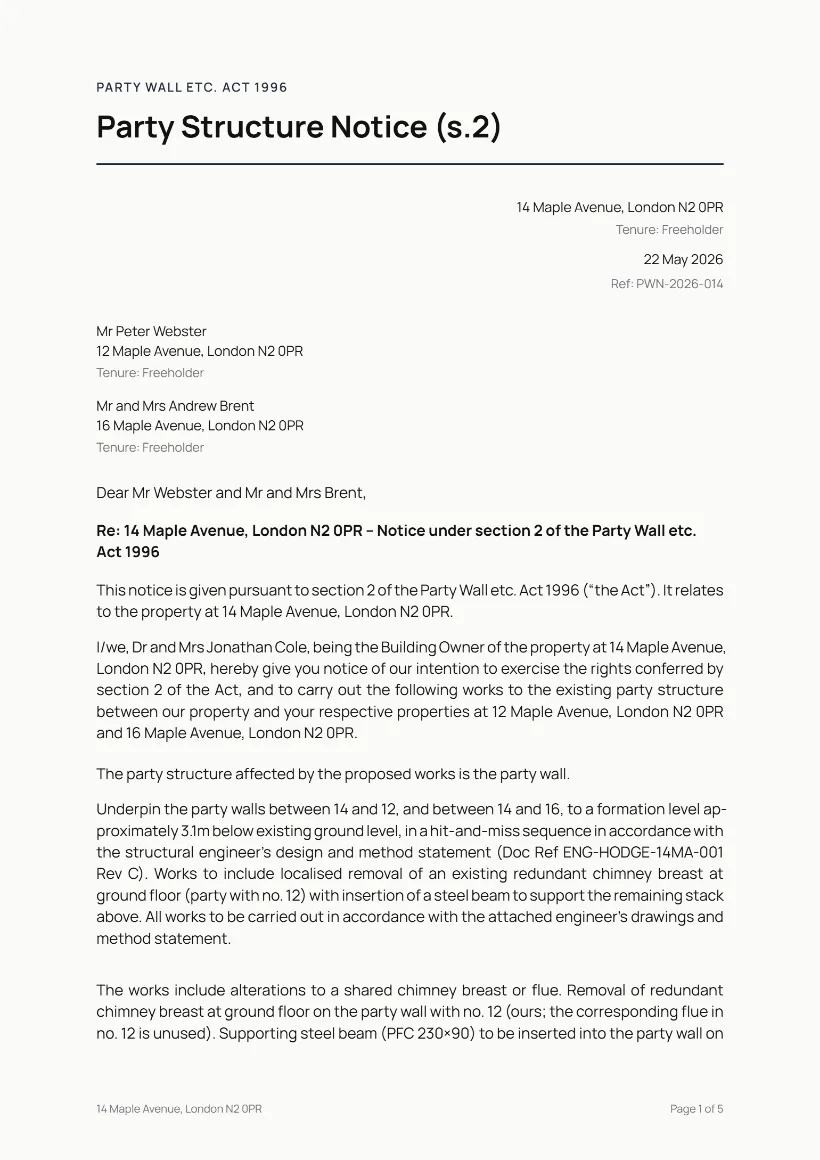
A complete, serve-ready notice. The notes alongside explain each part as you go. The content is fictional and the photos are placeholder slots.
Loading example…
Need your own format? We build it for you
Keep the format your firm already uses: we recreate it as a private template, or build a report type we don’t list. You approve a real PDF before you sign up. Bespoke report templates →
What goes in a party wall notice
The Act does not prescribe a form of notice, but it does prescribe what each type must state. A notice is a letter, not a tick-box form.
- ANotice detailsDate of the notice, which section the work falls under, whether a second notice type is combined into the same letter, the intended method of service, and whether a surveyor is serving as agent.
- BPartiesEvery building owner and adjoining owner as a named party — role, salutation, property address, correspondence address and tenure — so joint owners and multiple neighbours each get a correctly addressed notice.
- CProposed worksThe description that section requires: the intended wall for a line-of-junction notice, the work to the party structure, or the excavation with its depth. Chimney-breast removal and special foundations carry their own clauses.
- DSchedule & timingProposed start date, whether "or thereafter" is included, any request for an earlier start by written agreement, and the estimated duration of the work.
- ESurveyor arrangementsThe offer of an agreed surveyor — the cheaper single-surveyor route — with the prior-involvement disclosure, and a pointer to the government's explanatory booklet on the Act.
- FService & responseAddress for service, whether service by email is offered, the response period, and a tear-off acknowledgement and response form so the adjoining owner can consent or dissent in writing.
- GEnclosuresThe numbered schedule of drawings, sections, calculations and method statements sent with the notice, each with author, reference and date. Excavation notices must be accompanied by plans and sections.
- HSignatureSigned and dated by or for the building owner, stating the capacity in which it is signed, with a disclosure block where AI was used in drafting.
Which work needs a notice, and how much notice
Three parts of the Act create a duty to notify, and the notice period is different for each. Serving the wrong notice, or the right notice too late, leaves the building owner with no statutory protection — so the section is the first thing to get right.
| Notice | The work it covers | Notice period | How the adjoining owner responds |
|---|---|---|---|
| Line of junction — s.1(2) | Building a new wall astride the boundary line, where no wall stands there now | At least 1 month | They must consent in writing for the wall to be built astride the line. Without that consent the building owner may still build, but wholly on their own land and at their own expense. |
| Line of junction — s.1(5) | Building a new wall wholly on the building owner's own land, up to the boundary | At least 1 month | They cannot stop the wall. The building owner pays for it, may place projecting footings under the adjoining land where necessary, and must compensate for damage caused. |
| Party structure — s.2 | Work to an existing party wall or party structure: cutting in beams, raising, underpinning, rebuilding, removing a chimney breast | At least 2 months | 14 days to consent or dissent in writing. No reply is deemed dissent, and a dispute is deemed to have arisen. |
| Adjacent excavation — s.6(1) | Excavating within 3 metres of an adjoining building or structure, to a depth below its foundations | At least 1 month | 14 days to consent or dissent. No reply is deemed dissent. Plans and sections must accompany the notice. |
| Adjacent excavation — s.6(2) | Excavating within 6 metres where the excavation cuts a line drawn downwards at 45° from the bottom of the adjoining foundations | At least 1 month | 14 days to consent or dissent. No reply is deemed dissent. Plans and sections must accompany the notice. |
The building owner
The owner who wants to do the work. "Owner" is defined broadly — generally the freeholder, someone in receipt of the rents, a purchaser under contract, or a leaseholder holding for more than a year. A surveyor, architect or solicitor can draft and serve the notice as agent, but it is the owner's notice.
Every adjoining owner
Each owner of the neighbouring land or building, including joint owners and, in a flat, both the freeholder and the long leaseholder. Miss one and the notice is ineffective against them. Where the owner cannot be identified, the Act allows a notice addressed to "the owner" and fixed to a conspicuous part of the premises.
In person, by post, or at the premises
Delivered in person, sent to their usual or last-known residence or place of business, or — for a company — to its registered or principal office. Service by email only counts where the recipient has given an address for service by electronic communication.
What happens after a notice is served
The notice is the start of the process, not the end of it. Most projects end at step two.
The building owner serves the notice for the section the work falls under, on every affected adjoining owner. Work cannot lawfully begin until the notice period has run and the adjoining owner has consented, or an award has been made.
For a party structure notice or an excavation notice, the adjoining owner has 14 days to consent or dissent in writing. Consent ends the matter. Dissent, or no reply within the 14 days, means a dispute is deemed to have arisen. The adjoining owner may also agree in writing to an earlier start than the notice period allows.
Once a dispute arises, either both owners agree on a single agreed surveyor, or each appoints their own and those two select a third surveyor to hold in reserve. Appointments must be in writing and cannot be rescinded.
The surveyors make a party wall award setting out what work may be done, how and when, and who pays. It is served on both owners and binds them. Either owner has 14 days from service to appeal it to the county court.
Party wall notice vs party wall award
The two are routinely confused. A notice opens the statutory process; an award closes the dispute the notice may have triggered.
| Comparison | Party wall notice | Party wall award |
|---|---|---|
| What it is | Formal notification of work the owner intends to do | The document that settles the dispute and sets the terms of the work |
| Who produces it | The building owner, often drafted by their surveyor or agent | The agreed surveyor, or the two appointed surveyors — or the third surveyor if a matter is referred |
| Who receives it | Each adjoining owner | Both owners — it is served on the parties |
| When | Before the work starts, by the period that section requires | After a dispute has arisen or is deemed to have arisen |
| The verb | A notice is served | An award is made, then served on the parties |
| Is it always needed? | Yes, for notifiable work | No — if the adjoining owner consents to the notice, no award is required |
| Challenge route | The adjoining owner consents or dissents; silence is deemed dissent | Appeal to the county court within 14 days of service |
Read more on party wall awards, or on the schedule of condition that is normally annexed to one.
How SurveyorSuite produces a party wall notice
SurveyorSuite is report-writing software for UK surveyors. Pick the notice type and the document renders as a serve-ready letter in the right statutory form.
Dictate or type the project details, get a drafted description of works
Dictate notes on site or type them from the architect's drawings and the engineer's calculations. The AI turns them into the plain-English description of works the notice needs — what is being built, what is being cut into, how deep the excavation goes.
It works only from what you wrote — it does not invent dimensions, depths or construction. It does not decide which section applies, identify the adjoining owners, or choose the method of service: get those wrong and the notice is ineffective, so they stay with the named surveyor. You review every line and sign the notice. AI use is disclosed in the signature block and timestamped in the audit trail. The feature is optional; the software works the same way without it.
Read our full AI compliance position- All five notice types, each with its own wording
- Combined notices in a single letter
- Unlimited parties — joint and multiple owners
- Numbered enclosures schedule
- Acknowledgement and response form included
- Bulk import from the camera roll
- Drag each photo to the right part of the notice
- Arrow, box and label annotations
- Drawings and calculations logged as enclosures
- Works offline, syncs when back in signal
- Serve-ready letter in the statutory form
- Branded PDF with your logo and colours
- Word (.docx) export for further editing
- Export blocked until required fields are done
- Client database and audit trail
SurveyorSuite is £35 per month (£30 a month on annual billing), with all 16 report types, unlimited reports and 40 AI generations a month included.
Party wall notice FAQs
Which work needs a party wall notice?
How much notice do I have to give?
What happens if the adjoining owner doesn't reply?
Is there a free party wall notice template?
What's the difference between a party wall notice and a party wall award?
Can one notice cover more than one section?
Does the Party Wall etc. Act 1996 apply in Scotland or Northern Ireland?
Who signs the notice — the owner or the surveyor?
Is SurveyorSuite's AI aligned with the RICS AI standard?
What happens to my notes? Are they used to train AI models?
Draft party wall notices in SurveyorSuite
£35/month or £30/month annually. All 16 report types, unlimited reports.
1-month free trial · card captured, nothing charged during the trial · cancel any time
Last reviewed: · General information about the Party Wall etc. Act 1996, not legal advice. SurveyorSuite is not affiliated with or endorsed by RICS.